
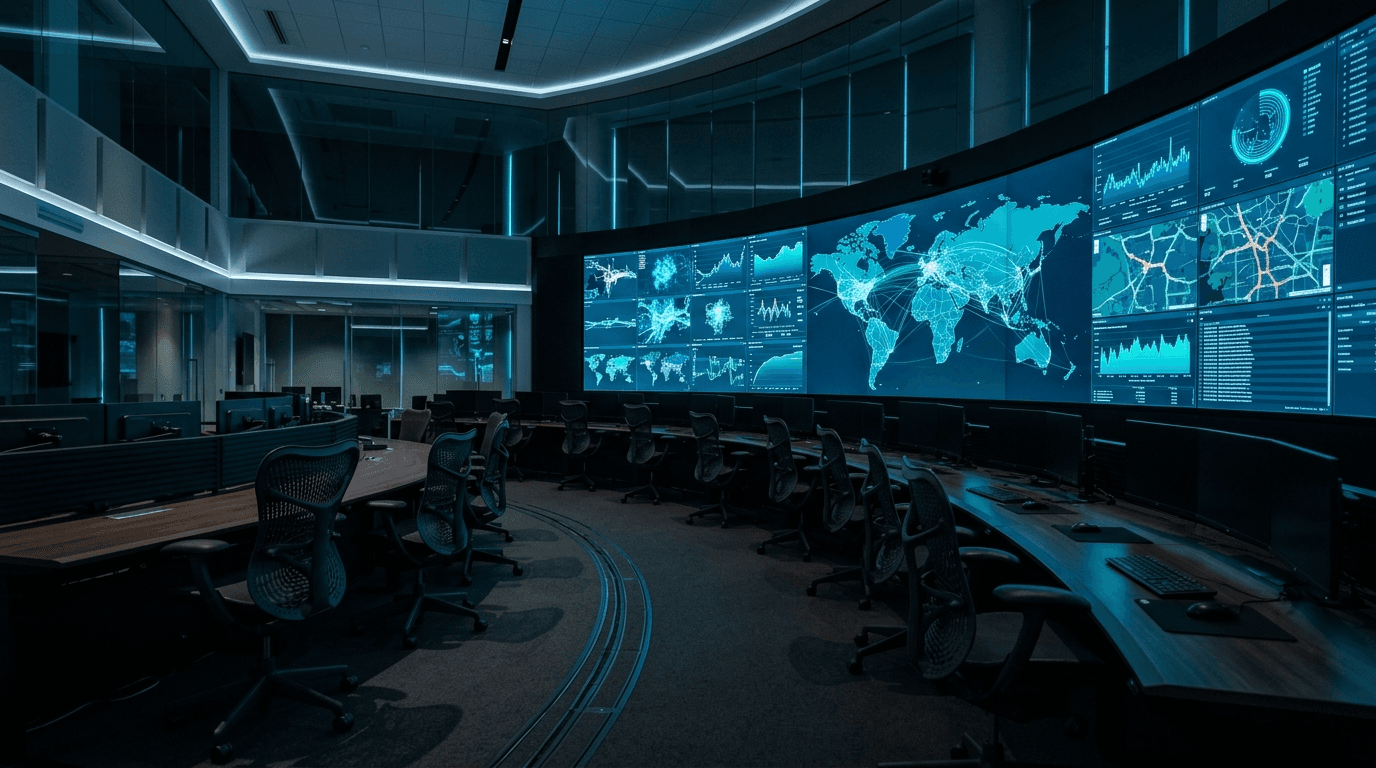
SOC as a service (SOCaaS) is a subscription that gives a small business a 24/7 security operations center it could never staff on its own: people, monitoring software, and detection playbooks that watch your systems around the clock and respond when something is wrong. For most small and mid-sized companies it is the only practical way to get continuous threat detection, because building the same capability in-house means hiring a team and buying enterprise tools. The question is not whether monitoring matters. It is whether you rent it or try to build it.
By The NetSys Group Team
What does a SOC actually do?
A security operations center collects logs and alerts from your laptops, servers, firewall, and Microsoft 365 accounts, watches them for signs of an attack, and acts when a real threat appears. The core job is speed: catch the intruder during the quiet hours between the first foothold and the ransomware, not after.
That work runs on three things. A SIEM (security information and event management platform) pulls in the data and flags suspicious patterns. Analysts triage the alerts so you are not drowning in false alarms. And a response process isolates an infected machine or disables a compromised account before the damage spreads. A SOC that only sends alerts and leaves you to act on them at 2 a.m. is not much of a SOC.
Why do small businesses need one now?
Because the gap between getting breached and noticing it is where the cost lives. IBM's 2025 Cost of a Data Breach report put the average time to identify and contain a breach at 241 days, the lowest in nine years, with the global average breach costing USD 4.44 million. Those numbers are driven by organizations that had no one watching. A small business with no after-hours monitoring is exactly the environment attackers prefer, because they can work all weekend undisturbed.
Endpoint tools help, but they are not the same as a SOC. If you are still sorting out the difference between antivirus, EDR, and MDR, start with our guide to EDR vs. antivirus vs. MDR. SOCaaS is the layer that sits above those tools and turns their alerts into action.
What does SOC as a service cost?
SOCaaS is usually priced per endpoint or as a flat monthly retainer. Per-endpoint plans run roughly USD 8 to 25 per device per month for mainstream detection and response, according to a 2026 SOCaaS pricing breakdown from BD Emerson, with flat retainers for mid-market firms landing between USD 5,000 and 25,000 a month. The same analysis notes a minimal in-house SOC with round-the-clock staffing clears USD 1 million a year in salaries alone before any tooling, which is why outsourcing wins for almost every company under a few hundred employees.
Watch the extras. Invoices often run 20 to 40 percent above the quoted rate once you add SIEM data ingestion, onboarding, and out-of-scope incident response. Ask any provider to price those before you sign.
SOCaaS vs. building it in-house
| Building in-house | SOC as a service | |
|---|---|---|
| Staffing | 5-6 analysts minimum to cover nights and weekends | Provider's 24/7 analyst team |
| Tooling | SIEM license plus someone senior to tune it | Included in the subscription |
| Cost model | Fixed payroll and licensing | Costs spread across many clients — you pay for the outcome |
| Trade-off | Full internal control | Partner gets deep visibility into your network — vet response authority |
A real in-house SOC needs at least five or six analysts to cover nights and weekends, a SIEM license, and someone senior to tune it. For a 40-person company that math never works. Renting the capability spreads those fixed costs across many clients, so you pay for the outcome, not the payroll. The trade-off is that you are trusting a partner with deep visibility into your network, which makes provider selection and clear response authority the parts worth getting right.
How to choose a SOCaaS provider
Look for genuine 24/7 coverage by humans, not just automated alerting; a clear commitment to respond and contain, not only notify; and transparent pricing that names the ingestion and incident-response fees up front. A provider that already manages your IT and security stack has a head start, because it knows your systems and can act without waiting for permission to touch a server it has never seen.
Frequently asked questions
What is the difference between MDR and SOC as a service?
MDR (managed detection and response) focuses on your endpoints, spotting and stopping threats on laptops and servers. SOC as a service is broader: it watches endpoints plus your network, cloud, and identity systems through a SIEM, with analysts and a response process. Many SOCaaS offerings include MDR as one component.
Is SOCaaS worth it for a business under 50 employees?
Often yes, if you hold sensitive data or must meet compliance rules. A small firm cannot staff 24/7 monitoring, and attackers target exactly that gap. At a few hundred dollars a month for a small endpoint count, SOCaaS costs far less than the downtime and recovery from a single ransomware event.
Does a SOC replace my antivirus and firewall?
No. A SOC sits on top of them. Your firewall, antivirus, and endpoint tools generate the signals; the SOC collects, correlates, and acts on those signals across your whole environment. You still need strong tools underneath, well configured and kept patched.
How fast can a SOC respond to an attack?
A well-run SOC detects and begins containing a serious threat in minutes to hours, not days. The value is the after-hours coverage: isolating a compromised machine at 3 a.m. on a Saturday, long before your team logs in Monday to find the network encrypted.
Not sure whether you need full SOC coverage or a lighter managed-security layer? Contact The NetSys Group for a complimentary risk assessment, and we will map your current gaps against what monitoring would actually catch.
The NetSys Group has delivered managed IT, cybersecurity, and cloud services since 1998. Our engineers hold degrees in electrical and computer engineering and are certified Microsoft and Cisco instructors, serving businesses across NY, NJ, CT, PA, and Southwest Florida.
Related reading
 Cybersecurity
Security Awareness Training for Small Business: Worth It?
Read Article Cybersecurity
SOC 2 Compliance for Small Business: Do You Need It?
Read Article Cybersecurity
SaaS Sprawl Is a Security Risk for Small Business
Read ArticleAlso on this topic: XDR vs SIEM for Small Business: Which Do You Need? · Browser Extension Security Risks for Small Business
Discuss cyber security for your business.
Tell us about your current systems, the result you need and your timeline. We will discuss the work, responsibilities and pricing before you decide on an engagement.