
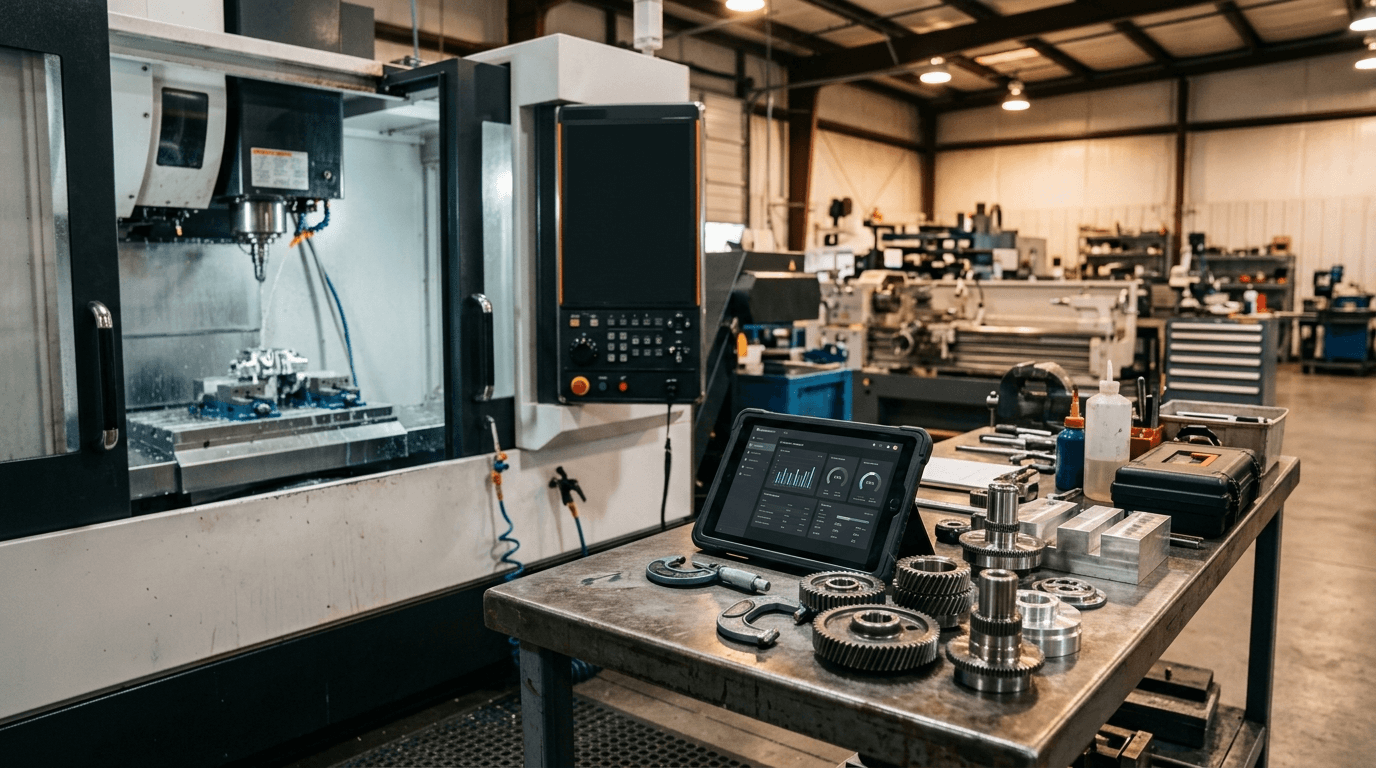
Start with the quote, not the robot. The fastest payback from AI in a small factory isn't a machine-learning vision system on the line. It's cutting the hours your team spends turning an RFQ into a price, chasing a late part, or rekeying an order that came in as a PDF.
Only 13.9% of U.S. manufacturers used AI in any business function as of February 2026, up from 1.8% in September 2023, according to a study of Census Bureau survey data. Small shops lag the big plants by a wide margin. That gap is the opportunity. You don't need a data-science team to close it.
Where does AI automation pay off first in a small factory?
Quoting, order entry, inventory, and scheduling. These are the paperwork jobs that sit between a customer's request and a finished part, and they're where a small manufacturer bleeds the most billable hours. Automating them is cheaper, faster, and lower-risk than touching anything on the production floor.
Fix the office before you touch the machines. The floor is where the risk lives; the back office is where the easy money is.
Quoting and estimating
An estimator who spends a day per quote is your bottleneck. AI tools can read an incoming drawing or spec, pull comparable past jobs, and draft a first-pass estimate in minutes. The estimator still signs off. But they're editing a draft instead of starting from a blank sheet.
Win rate goes up too, because you can quote more jobs and respond same-day instead of next-week.
Order entry and document handling
Orders still arrive as emailed PDFs, faxes, and portal exports. Someone rekeys them into your ERP. That's slow, and it's where wrong quantities and shipping errors start.
AI document processing reads the incoming order, extracts the line items, and drops them into your system for a human to confirm. We covered the mechanics of this in AI invoice processing for small business. The same approach works for purchase orders and packing lists.
Inventory and demand forecasting
Reorder points set once in 2019 don't match how you buy now. AI forecasting looks at your actual usage, lead times, and seasonality, then flags what to reorder before you run short, without the overstock that ties up cash on the shelf.
Production scheduling
When a rush job lands or a machine goes down, someone rebuilds the schedule by hand. AI scheduling reshuffles jobs against due dates, machine availability, and material on hand, and shows you the trade-offs so you can make the call fast.
What should a small manufacturer NOT automate yet?
Anything safety-critical, anything touching machine controls, and anything you can't check. Predictive maintenance and computer-vision quality inspection are real, but they need sensor data, integration work, and a budget most 20-to-100-person shops aren't ready to spend. Start where a human reviews the output before it matters.
Keep AI away from your OT network, too. Automating the back office shouldn't open a door to the production floor.
Does this create a security problem?
It can, if you bolt AI onto an already-exposed network. Manufacturing was the most-attacked industry for the fifth straight year, at 27.7% of all cyberattacks in 2025, according to IBM X-Force data. Attackers target factories because downtime is so expensive that many pay to get running again.
Before you feed shop data into any AI tool, know where that data goes and who can see it. Segment the network so office tools can't reach machine controls. That's foundational work we walk through in cybersecurity for manufacturers.
How do you start without wasting money?
Pick one workflow, measure the hours it eats today, automate that one, and check the result in 30 days. Don't buy a platform for a problem you haven't measured. A single automated quoting or order-entry flow usually pays for itself before you've rolled out the second one.
If you already run Microsoft 365, some of this is tooling you own. The rest is off-the-shelf software wired into your ERP, not a custom build.
Frequently asked questions
Do I need to replace my ERP to use AI?
No. Most AI automation connects to the ERP you already run, reading orders into it and pulling usage data out of it. Replacing a working ERP is a bigger, riskier project than adding automation around it. Start with the connections, not a rip-and-replace.
How much does it cost for a small manufacturer?
It depends on the workflow, but back-office automation usually starts in the low hundreds of dollars a month per tool, not a six-figure capital project. Because you can start with one workflow, you can prove the return before spending more.
Will AI make mistakes on my orders?
It will, which is why every workflow worth running keeps a human check before anything ships or bills. Done right, AI handles the rekeying and a person confirms. Fewer errors than manual entry alone, not more.
What's the single best place to start?
Whichever manual task eats the most staff hours right now. For most small manufacturers that's quoting or order entry. Measure the hours first, then automate the biggest one.
Is my shop too small for this?
No. Smaller shops often see faster payback because one automated workflow removes a bigger share of the total admin load. The tools scale down fine; the constraint is picking the right first job, not company size.
The NetSys Group helps manufacturers across the NY-metro region and beyond wire AI into the systems they already run, safely, starting with the workflow that pays back fastest. Book a complimentary AI readiness assessment and we'll help you find your first one.
About the author: Jamie Baum leads AI and automation strategy at The NetSys Group, which has delivered managed IT, cybersecurity, and cloud services since 1998. NetSys engineers hold degrees in electrical and computer engineering and are certified Microsoft and Cisco instructors, serving businesses across NY, NJ, CT, PA, and Southwest Florida.
Related reading
 AI Automation
AI Automation for Wholesale Distributors and Importers
Read Article AI Automation
AI Automation for Insurance Agencies: Where It Pays Off
Read Article AI Automation
AI Automation for Professional Services Firms
Read ArticleAlso on this topic: AI Automation for E-Commerce: Where It Pays Off · AI for Restaurants: Phone Orders, Reservations and Back-Office Automation
Discuss ai workflow automation for your business.
Tell us about your current systems, the result you need and your timeline. We will discuss the work, responsibilities and pricing before you decide on an engagement.