
Smart Privacy Film Installation for Offices
Clear when you want it. Private when you need it. NetSys plans and installs LC privacy film for glass offices and conference rooms, with measurement, scheduling and a clean finish built into the process.
The short answer
Smart privacy film installation adds a switchable liquid crystal (LC) film to existing office glass, so a conference room or office can go from clear to frosted at the flip of a switch. NetSys reviews your glass, measures each pane, does the wiring and controls, and installs the film around your schedule anywhere in New York, New Jersey and Connecticut.
Closest related page: AI-enabled executive office. That page covers the whole room, from displays and conferencing to the network; this one covers only the switchable film on its glass.
From measuring the glass to private at the flip of a switch
Illustrative demonstration, not footage of a client installation. The sequence is sped up and does not show how long a real installation takes.
Transcript
NetSys brings privacy to your glass office. We measure precisely, schedule around your business and install custom-fitted smart film with a clean, seamless finish. Then with one switch, clear glass becomes private. Your space, your schedule, privacy on demand.
The same glass wall, clear and private
Drag the handle left or right to switch the glass between clear and private, and see how the film changes the view while the wall still reads as a glass partition.
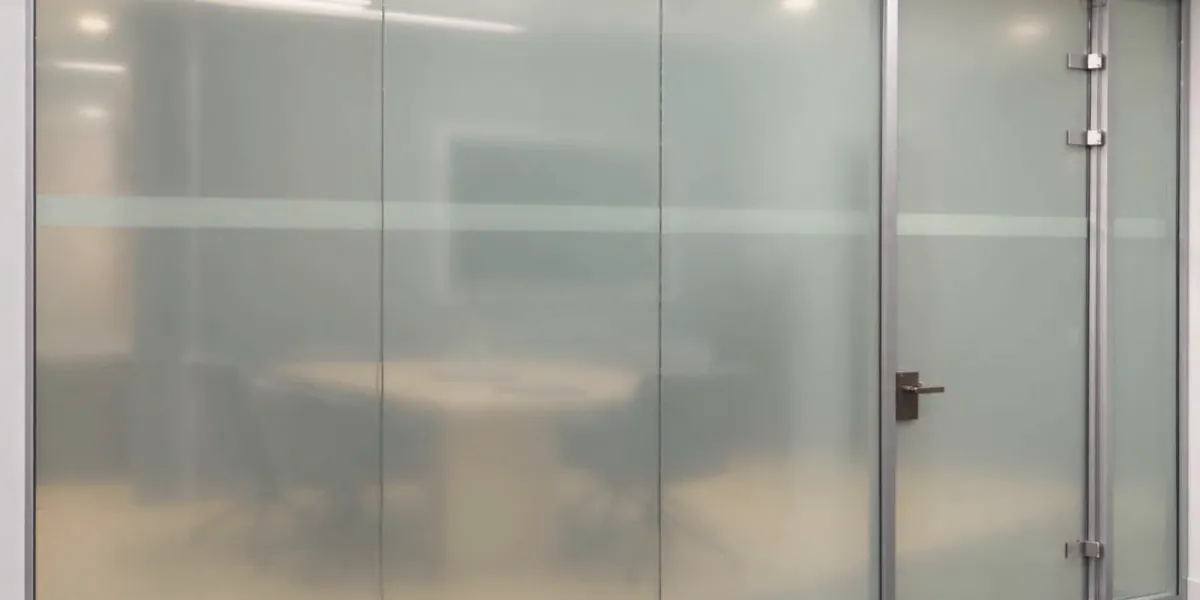
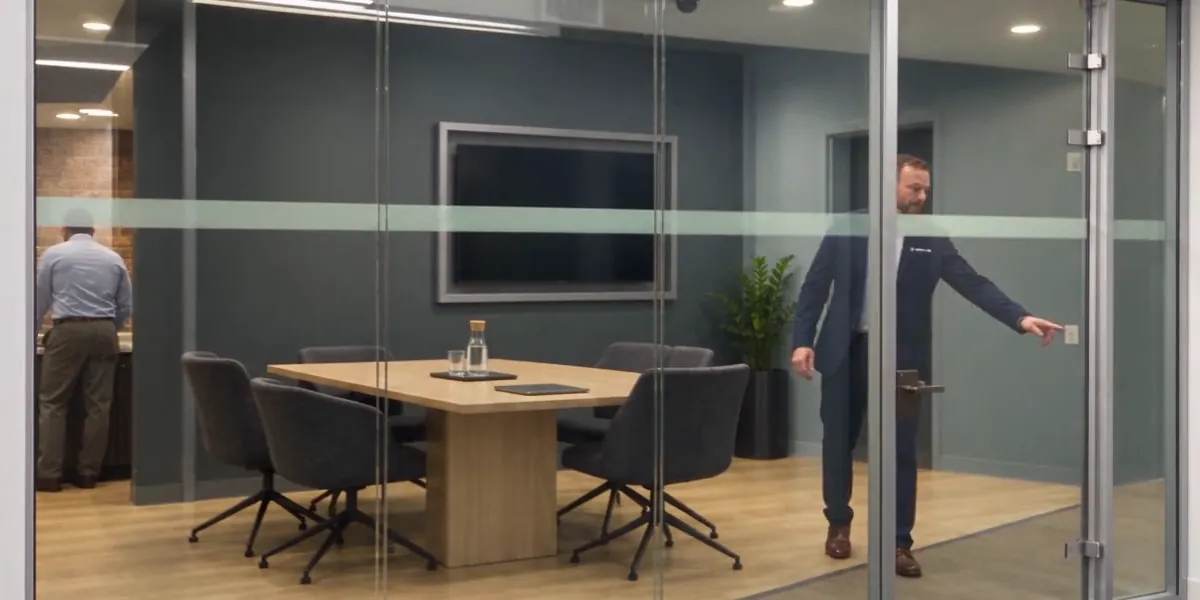
Frames from the illustrative demonstration above. Frosted film still passes about 55 to 67% of the light as a soft glow while see-through drops to a few percent, and how private it looks up close depends on the film and the lighting on each side.
Glass-walled offices and conference rooms make a floor feel open, right up until a board meeting, a performance review or a client call needs to stay out of view. Blinds and fixed frosting solve that by closing the room off for good. Switchable film keeps the glass clear for everyday work and turns it frosted when the room needs privacy.
The film is applied to the inside face of glass you already have. A controller steps building power down to the low AC voltage the film runs on, and a wall switch, a remote or a room control system flips it between clear and private in a fraction of a second. Some people call it an LC privacy screen; it is film on glass, not an electronic display. We plan the film, the power and the controls together, and we install it around the way your rooms are used.
Why an IT firm installs privacy film
The rooms that need privacy are usually the ones we already equip: executive offices and conference rooms with displays, cameras and meeting-room systems. Planning the film with the room means the power supply, the wire runs and the controls fit around the technology already there, and you have one contact for the whole room.
Privacy for Glass Offices and Conference Rooms
Conference Rooms
Open for everyday use, private when the meeting starts.
- Film on the glass walls facing the office floor
- Frosted for board meetings, interviews and client calls
- One switch at the door, or tied into the room's controls where the film's controller supports it
- Clear again for the next booking
Executive Offices
A glass office that can close itself off for a conversation.
- Privacy for HR, legal and finance conversations
- Keeps daylight moving into the office when the film is clear
- A switch or remote within reach of the desk
- Planned alongside the office's displays and conferencing
Client Meeting Rooms
Confidential conversations in rooms that visitors walk past.
- Documents on the table stay out of view from the corridor
- Screens and whiteboards are hidden when the glass is frosted
- A clean, finished look for reception-facing rooms
- Scheduled installation so the room is out of use for as little time as possible
- Care instructions left with your office manager
Internal Glass Partitions
Privacy on the panes that need it, clear glass everywhere else.
- Film cut to fit each pane of a partition or sidelite
- Individual panes can switch separately, depending on the wiring plan
- Suitability of each pane reviewed before we confirm the scope
- Coordinated with building management for access and electrical work
Why offices bring us their glass
Send the project address, rough pane sizes and a few photos. We will tell you whether your glass suits switchable film, what the job involves and what happens next. Call 845-203-3914 or request an estimate.
- One contact for the room: the film, its controls and the technology the room already runs
- We review every pane before we confirm the scope, and tell you if a pane is not suitable
- Work is scheduled around your meetings and how the rooms are used
- Straight answers on limits: the film gives visual privacy, not soundproofing or blackout
- We install across the tri-state area: New York, New Jersey and Connecticut
- Based in Brooklyn, in business since 1998
What the installation covers
This service retrofits switchable film onto glass you already have. Here is what that includes, and what it does not.
| Part of the project | Included | Not included |
|---|---|---|
| Glass | A review of each pane's size, edges and surface before the scope is confirmed | Replacing panes or supplying factory-laminated smart glass |
| Film | Switchable film specified for your glass and cut to fit each pane | Blackout: frosted film still lets most of the light through, diffused |
| Power and controls | The power supply, wiring and switching, planned with you and installed by us: a wall switch, a remote or a room control system | Controls the selected film's controller does not support |
| Privacy | Visual privacy when the film is switched to private | Sound privacy: the film changes what people see, not what they hear |
How LC privacy film behaves
Typical values for switchable liquid crystal (PDLC) film, from manufacturer specification sheets. The product we specify for your glass comes with its own data sheet, and we check it against these before you commit.
| Property | Typical value |
|---|---|
| With the power off | Frosted. Standard film is clear only while powered, so a power cut leaves the glass private. Reverse film that is clear when off exists, but it is less common and costs more |
| Power supply | About 48 to 65 volts AC from a controller on a standard 110 to 120 volt circuit, plug-in or hardwired |
| Power use | A few watts per square meter while clear, most often 3 to 5 (about 0.3 to 0.5 watts per square foot); none at the film when frosted |
| Switching time | About 10 to 80 milliseconds to clear, and up to about a fifth of a second to frost |
| Clear | About 75 to 90% of visible light passes, with a slight haze that grows when you look at the glass at a sharp angle |
| Frosted | About 55 to 67% of the light still passes as a soft glow, but seeing through drops to about 2 to 5%. It works the same from both sides |
| UV | About 98% to over 99% blocked in both states. Standard film is for privacy, not heat control |
| Rated life | Millions of switching cycles, and 10 years or more indoors when edges stay dry and the wiring is right |
| Temperature | Interior grades are rated from about 14°F up to 140°F or more |
| Manufacturer warranty | Usually 1 to 2 years on retrofit film and 2 to 5 years on laminated glass, often with paid extensions and an authorized-installer requirement |
Ranges from Gauzy, Polytronix, Innoptec, Pro Display, Smart Tint and Microchip documentation, checked September 2026. Makers differ; the data sheet for the film you choose is what counts.
From measurement to a finished installation
Five steps, adapted to your building and the way your rooms are used.
- Assess: we review the glass, access to it and how private each room needs to be. Photos let us start before a site visit.
- Plan: we confirm pane sizes, the film specification, the power supply and wire routes, and how the film will be switched.
- Schedule: we coordinate building access and time the work around the rooms' meetings.
- Install: we clean and prepare each pane, apply the film to the specification and do the wiring ourselves, from each pane to its controller and switch.
- Test: we switch every pane through both states with you, walk you through the controls and leave the manufacturer's care instructions.
What affects your privacy film estimate?
Your estimate depends on glass area, pane count, surface condition, access, electrical work and controls. Share your project location and a few photos so we can review the scope and explain the next step.
| Factor | Why it moves the estimate |
|---|---|
| Glass area | The film is sized to each pane, so the total area of glass drives the material cost |
| Pane count | Every pane is cut, fitted and connected on its own, so many small panes can take longer than a few large ones |
| Surface condition | Old adhesive, scratches or an existing film have to be dealt with before new film goes on |
| Access | Pane height, furniture and building rules on working hours all change the labor involved |
| Electrical work | Whether there is power near the glass, or new circuits and wire runs are needed |
| Controls | One wall switch per room is simpler than per-pane switching or a link to a room control system |
The example below shows what a typical job comes to. We quote your own from photos, approximate pane sizes and the project location.
Example project: 170 square feet of glass
What a typical job comes to, all in.
| Example project | 170 square feet of glass |
|---|---|
| Glass covered | 170 square feet, roughly a 20-foot glass wall at a standard ceiling height |
| Included | Measuring, film cut to each pane, installation, wiring and controls |
| All-in cost | About $24,000 to $28,000 |
| What moves it | The number of panes, access to the glass, surface preparation and how the film is switched |
An example of our pricing, not a quote. Send photos, approximate pane sizes and your address in New York, New Jersey or Connecticut for your own estimate.
Ready for an estimate?
Tell us about your glass, location and timing. Photos are welcome if you have them.
Smart Privacy Film Installation FAQs
What is LC privacy film?
LC, or liquid crystal, privacy film is a switchable layer applied to glass that changes between clear and frosted when its power is switched. It is also called PDLC film, switchable privacy film or smart film. It is film on glass, not an electronic display screen, and how it performs depends on the product selected.
Can privacy film be installed on existing glass?
Often, yes. Switchable films made for retrofit are applied to existing smooth glass. Whether your glass is suitable depends on the film, the condition of the surface, the pane sizes and edges, and where the glass is. We review each pane before confirming the scope, and tell you if one is not a good candidate.
How much does smart privacy film installation cost?
As an example, a job covering 170 square feet of glass, roughly a 20-foot glass wall, comes to about $24,000 to $28,000 all in, including the film, installation, wiring and controls. Your own figure depends on the glass area, the number of panes, surface preparation, access and controls. Send photos, approximate pane sizes and your project location, and we will review the work involved and what an estimate would cover.
How long does installation take?
Film is made to the exact size of each pane after the measurements are approved. Manufacturers quote from a couple of days to about ten days to produce it, laminated glass can take up to about four weeks, and site conditions and electrical work add their own time. We confirm the schedule once we have reviewed the scope, and plan the work around how your rooms are booked. The demonstration video on this page is sped up and does not show how long a real installation takes.
Is privacy film soundproof or blackout?
No. Smart privacy film gives visual privacy only. It does not block sound, and frosted film still passes about 55 to 67% of the light as a soft glow. Under strong backlighting, such as a lit room at night, a person standing right against the glass can show as a faint outline. For confidential calls, plan the room's acoustics separately.
What happens to smart film when the power is off?
Standard LC (PDLC) film is frosted with no power and clear only while powered, so a power cut leaves the glass private. Reverse film that is clear with the power off does exist, but it is less common, costs more and goes clear in an outage. We confirm how the selected film behaves before installation.
What cleaning and warranty come with the film?
Clean with the film switched off, use a soft cloth and a mild cleaner rather than ammonia, bleach or anything abrasive, and keep water away from the film's edges; the manufacturer's own care instructions stay with you after the install. Film warranties are usually one to two years on retrofit film and two to five on laminated glass, and most exclude installation faults, cutting in the field and water damage. Coverage comes in two parts, the manufacturer's for the film and ours for the workmanship, and your proposal states each with its length and exclusions.
How much power does smart privacy film use?
Very little. The film runs on about 48 to 65 volts AC from a controller fed by an ordinary 110 to 120 volt circuit, and draws a few watts per square meter while clear, most often 3 to 5. When it is frosted the film itself draws nothing.
How fast does smart film switch between clear and private?
Almost instantly. Manufacturers list about 10 to 80 milliseconds to go clear and up to about a fifth of a second to go frosted, so the change looks immediate from across the room.
How is the film controlled?
Usually with a wall switch or a remote. Depending on the controller, it can also dim to partial privacy, work from a phone app or a voice assistant, follow a timer or a motion sensor, or take commands from a room or building control system. A multi-channel controller lets panes switch in separate zones.
Does smart film block UV light and heat?
It blocks about 98% to over 99% of UV light in both states. Standard film is a privacy product, not a heat-control one; cutting solar heat needs a solar-control grade of film.
How long does smart privacy film last?
Manufacturers rate PDLC film for millions of switching cycles and about 10 years or more indoors. The usual causes of early failure are moisture reaching unsealed edges, heat and direct sun, and incorrect wiring, which is why the edges are sealed and the wiring is planned before the film goes on.
Can the frosted glass double as a projection screen?
Yes. In its frosted state the film works as a rear-projection screen, with the projector on the far side of the glass, and the image shows from both sides. Front projection needs an extra reflective layer.
Where do you install privacy film?
Across the tri-state area: New York, New Jersey and Connecticut, from our office in Brooklyn. Include the project address or ZIP code with your request, and we will confirm the scope and the schedule before anything is booked.
Sources and technical references
- Gauzy architect and designer catalog (2025): PDLC light transmission, haze, power, switching and warranty
- Polytronix Polyvision technical data: transmission, haze and switching time
- Microchip application note on PDLC drivers: AC supply voltage and why direct current damages the film
- Innoptec smart film FAQ: power use, haze and rear projection
- Smart Tint: standard film frosted when off, and a reverse film that is clear when off (an example, not the product NetSys installs)
- Smart Tint warranty terms: length, registration and common exclusions
Related services
Tell us about your glass.
Send the project location, rough pane sizes and your timing. Photos are welcome if you have them. We will review the scope and explain the next step.