
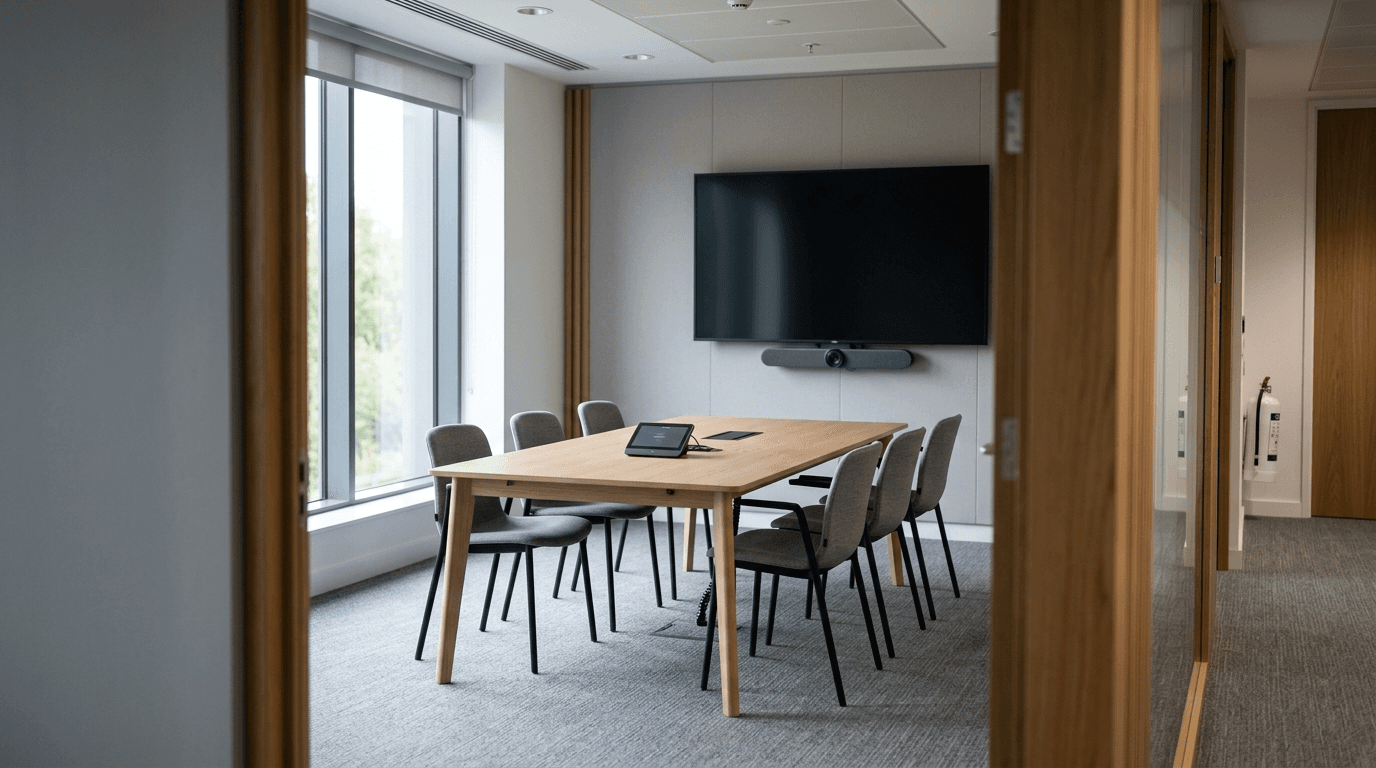
Most small offices don't need to pay for Teams Rooms. Microsoft gives away Teams Rooms Basic for up to 25 rooms, and for a two-room office that runs ordinary meetings, Basic does the job. Pro costs $40 per room per month and earns it only when you need the management, the security controls, or the camera intelligence.
Key takeaways:
- Teams Rooms Basic is free, capped at 25 rooms per organization.
- Teams Rooms Pro is $40 per room per month on an annual subscription.
- Buy Pro for Conditional Access, remote management, door panels, or rooms where hybrid meetings actually matter.
- You license per room, so you can mix the two.
What is Microsoft Teams Rooms?
Teams Rooms is the software that turns a conference room's TV, camera, mic, and touch console into a single Teams device. Walk in, tap the name of the meeting on the console, and you're in. No laptop, no HDMI cable, no dongle.
It runs on certified hardware from vendors like Logitech, Poly, Yealink, Crestron, and Lenovo. The license is separate from the hardware, and that's the part people get wrong when they budget for a room.
What's the difference between Teams Rooms Basic and Pro?
Basic is free and covers one-touch join, wireless content sharing, and the shared whiteboard. Pro is $40 per room per month and adds remote management, device analytics, Conditional Access, front row layouts, dual screens, meeting chat on the console, and intelligent camera features. Microsoft caps Basic at 25 licenses per organization.
That cap is the first filter. Under 25 rooms, you have a real choice. Over 25, the extras have to be Pro.
What Basic covers
- One-touch join from the room console
- Wireless content sharing
- Shared digital whiteboard
- Basic security and management
- One certified Teams Rooms system per room
- Available worldwide in Commercial, Education, and Non-Profit
What only Pro gives you
- Remote management and analytics. Push configuration, see device health, get alerts when a room goes offline.
- Conditional Access. Microsoft Entra policies apply to the room account.
- Front row. The layout that puts remote people at eye level along the bottom of the screen.
- Large gallery. The many-participant view on the room display.
- Dual screens and meeting chat on the room display.
- Intelligent camera and audio. Speaker identification, multi-camera support, panoramic room view, AI noise suppression, people counting.
- Teams Phone on the room device and end-to-end call encryption.
- Teams Panels — the tablets outside the door that show whether a room is booked. Microsoft's licensing page is explicit that Basic licenses don't cover panels.
When does a small business actually need Pro?
Four situations. If none of them describe you, stay on Basic.
You have a compliance requirement that names Conditional Access. A room account is an identity. If your cyber insurance questionnaire or your regulator expects Conditional Access on every account, the room can't be the exception. That's a Pro feature, and it's the cleanest reason to buy it.
Nobody is in the building to fix the room. With Basic, a room that stops working needs hands on it. With Pro, your IT team sees the failure in the portal and often fixes it remotely. For a firm with offices in three towns, that difference is the whole purchase.
Your meetings are mostly hybrid and the room is losing. If the people dialing in can't tell who's talking, front row and speaker identification fix a real problem. If everyone in the room is also on their laptop anyway, they don't.
You want room panels outside the door. Panels require Pro. There's no workaround.
What does a room actually cost?
The license is the small number. In the small-room builds we quote as of September 2026, the bundle — camera, speakerphone, touch console, and the compute unit — usually lands in the low thousands per room, before the display, the mounting, and the cabling work. Your reseller's numbers will differ; get a quote against the specific room. Budget the install, not just the box.
Then there's the resource account. Every room needs a Microsoft 365 account to hold its calendar, and the Teams Rooms license covers the meeting entitlement on that account. Microsoft's licensing guidance is that per-user Microsoft 365 suite licenses aren't authorized for shared meeting devices, so don't budget a Business Premium seat for the room.
A two-room office on Basic: hardware, cabling, and zero recurring license cost. The same office on Pro: $960 a year. That's the decision, and for most small offices it isn't close.
Can you mix Basic and Pro?
Yes, and you usually should. Licensing is per room. Put Pro on the board room that runs client meetings and Basic on the huddle room where three people take a stand-up.
One caveat: management follows the license. Both tiers enroll in the Teams Rooms Pro Management portal for inventory, but only Pro rooms get the detailed device information, remote configuration, and analytics. So you're also choosing which rooms you can fix from a desk.
What to do before you buy anything
Count your rooms and rank them by who sits in them. The room where you pitch clients and the room where you eat lunch have different requirements, and buying one license tier for both wastes money in one direction or the other.
Then check the network. A Teams Rooms system is a video endpoint on your LAN, and a room that stutters is usually a switch or Wi-Fi problem, not a license problem. Our managed IT services team looks at the room and the network together, because fixing one without the other doesn't hold. If you're still deciding on the phone side of Teams, our breakdown of Teams Phone vs RingCentral vs Zoom Phone covers that separately, and our Teams Phone FAQ answers the licensing questions that come up next.
Frequently asked questions
Is Microsoft Teams Rooms Basic really free?
Yes. Basic carries no license cost and is available worldwide in Commercial, Education, and Non-Profit. You still pay for certified hardware and installation. The limit is 25 Basic licenses per organization; rooms past 25 need Pro.
Do I need a Microsoft 365 license for each conference room?
Not a user license. Each room gets a resource account for its calendar, and the Teams Rooms license — Basic or Pro — covers the meeting entitlement on that account. Microsoft's guidance is that per-user suite licenses aren't authorized for shared meeting devices anyway.
Can I use a regular PC instead of certified hardware?
Not for Teams Rooms. Both licenses require a certified Teams device. A PC with a webcam running the Teams desktop app is a different setup: it works, but you lose one-touch join, the room calendar, and central management.
What happens if I stop paying for Pro?
The device loses the Pro management capabilities right away. It doesn't fall back to Basic on its own — you have to buy and assign a Teams Rooms Basic license, and only if you're under the 25-license cap.
Does Teams Rooms work with Zoom or Google Meet?
Certified Teams Rooms devices can join Cisco Webex, Zoom, and Google Meet through Direct Guest Join, which is included with both Basic and Pro. Google Meet is Windows-only. The experience is stripped down compared with a native Teams meeting, so check the specific device before you promise it to anyone.
If you're planning a new office, an added conference room, or a Teams rollout that has to work the first time, get in touch for a complimentary assessment. We'll look at the rooms, the network, and the licensing together and tell you where Basic is enough.


Turn insight into action.
Take a free cybersecurity or AI readiness assessment, or book a call with a NetSys engineer — no obligation, no runaround.