
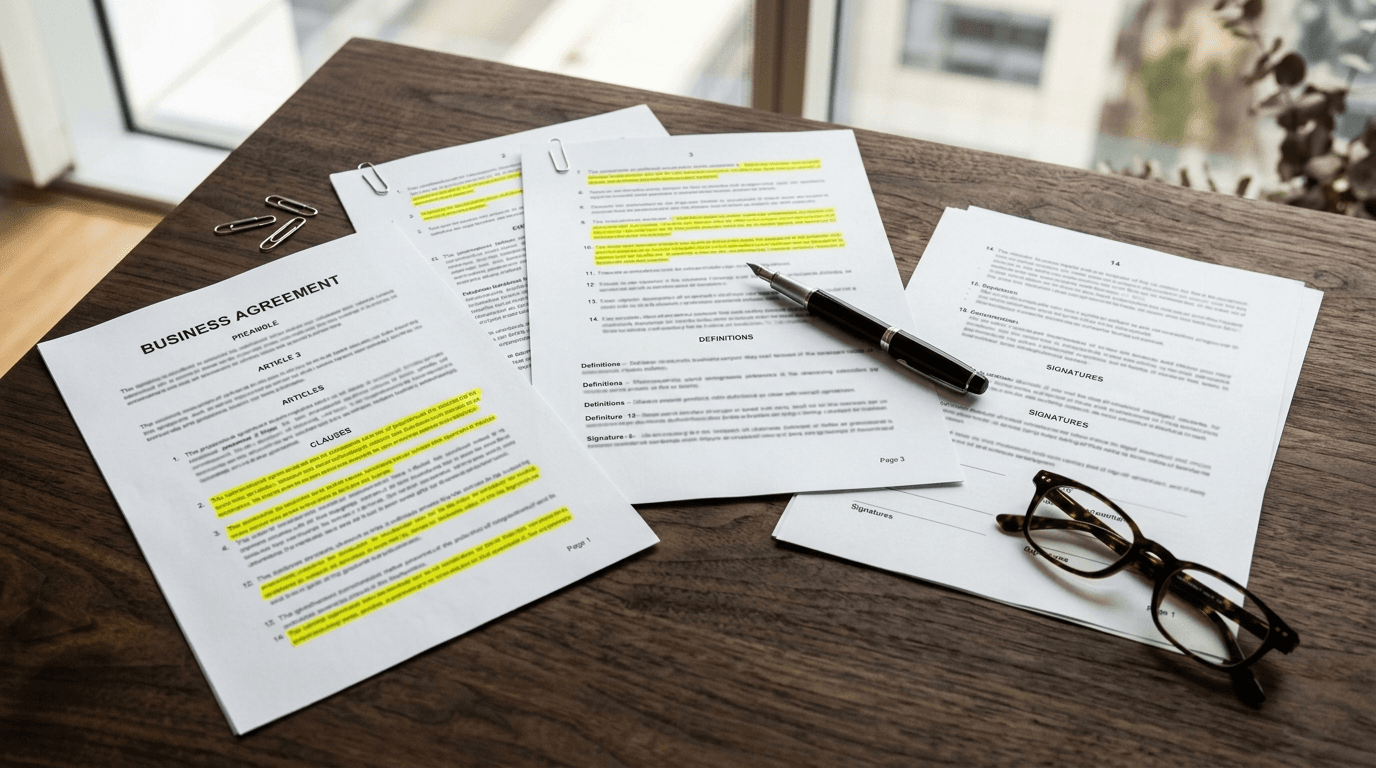
AI is good at the first read of a contract and bad at the final word. Use it to summarize terms, flag unusual clauses and compare a vendor's paper against your standard.
Don't use it to decide whether to sign. That's still a job for you and, when the stakes are real, your lawyer.
Done that way, it turns an hour of reading into ten minutes of checking. Done wrong, it hands confidential terms to a consumer chatbot and gives you false confidence.
What can AI actually do with a contract?
AI can read a contract and produce a plain-English summary, a list of key dates and obligations, and a set of clauses that look unusual or one-sided. It's fast at the tedious part: finding the auto-renewal notice window, the liability cap and the termination terms buried on page 14.
The tasks it handles well:
- Summaries. Who owes what, by when, for how much.
- Clause extraction. Renewal terms, payment terms, indemnification, limitation of liability, governing law.
- Comparison. "Here's our standard MSA. What's different in theirs?"
- Question lists. Drafting the questions to send back to the vendor or to your attorney.
- Deadline tracking. Pulling renewal and notice dates into a calendar so a contract doesn't auto-renew on you.
Where does AI contract review go wrong?
It's confidently wrong, and it can't tell you what's missing that should be there.
The evidence is sobering. Stanford's May 2024 report notes that its earlier study found general-purpose chatbots hallucinated between 58% and 82% of the time on legal queries.
The new study tested paid tools. Even purpose-built legal research tools from LexisNexis and Thomson Reuters produced incorrect information more than 17% of the time.
Both studies tested legal research questions, not contract markups, but the lesson carries over: the output reads well whether it's right or not.
The failure modes to watch for:
- Invented clauses. The summary says there's a 30-day cure period. There isn't.
- Missed context. A clause that's standard in software licensing is a red flag in a construction subcontract. AI doesn't know your industry's norms unless you tell it.
- Silence on gaps. AI reviews the words on the page. It rarely flags the data-breach notification clause that isn't there.
- State law. Enforceability of non-competes, auto-renewal rules and indemnities varies by state. Don't rely on a chatbot for that.
Is it safe to upload contracts to AI?
Only into a tool your business controls. A free consumer chatbot is the wrong place for a client agreement, an NDA or a lease with confidential pricing. Depending on the product and settings, what you paste can be retained or used for training.
Use a business-grade tool instead. Microsoft 365 Copilot works inside your tenant and, per Microsoft, only surfaces data the user already has permission to view, which is also why you should fix SharePoint oversharing before turning it on.
OpenAI says it doesn't use ChatGPT Business and Enterprise data for training by default, and Anthropic says the same for Claude's commercial products. Either way, check the terms and settings before anyone uploads a contract, and put the rule in your AI usage policy.
Some contracts also restrict sharing their terms with third parties. Read the confidentiality clause before you feed the document to any outside service.
Our AI data privacy FAQ covers the rest, and we'll run a complimentary AI risk review if you're unsure which tools are safe.
How should a small business set it up?
Keep it simple and keep a person in the loop.
- Pick one approved tool. Choose one business-licensed tool and confirm its retention and training settings.
- Write a standard prompt. Ask for a summary, every date and dollar amount with its section number, and a list of clauses that favor the other party. Section numbers let you check each claim in seconds. A version you can copy: "Summarize this contract in plain English. List every date, deadline and dollar amount with its section number. List clauses that favor the other party, with section numbers. Then list standard protections this contract is missing. If you can't cite a section, say so."
- Give it your playbook. Your preferred payment terms, your liability cap, the clauses you never accept. AI compares against a standard far better than it judges in a vacuum.
- Verify everything it flags. Open the contract and read the cited section. If it can't point to a section, treat the claim as false.
- Set a lawyer threshold. Anything over a set dollar value, multi-year, or involving indemnity, IP or personal guarantees goes to counsel. AI prepares the questions; your lawyer answers them.
For routine paper like NDAs, SaaS renewals and vendor agreements, that workflow saves real time. For an acquisition or a commercial lease, AI is a reading aid and nothing more.
Do you need a special contract review tool?
Usually not at small-business volume. If you're reviewing a few contracts a month, a business-grade general assistant with a good prompt and your playbook does most of the work.
Dedicated contract tools earn their cost when you handle dozens of agreements a month, need a searchable clause library, or want renewals tracked automatically across a portfolio. If that's you, it's worth connecting contract intake to your document workflow. Our AI document automation work starts there.
This is general guidance, not legal advice. Talk to your attorney about any contract that matters.
AI contract review FAQ
Can AI replace a lawyer for contract review?
No. AI can summarize a contract and flag clauses worth questioning, but it can't give legal advice, judge enforceability under your state's law or negotiate for you. Use it to show up to your lawyer with better questions and a shorter bill, not to skip the lawyer on contracts that matter.
Is ChatGPT good at reviewing contracts?
It's good at summarizing and spotting one-sided language, and unreliable on legal conclusions. The free consumer version is the wrong place for confidential contracts. Use a business plan, confirm training is off, ask it to cite section numbers, and check every flagged item against the actual text.
What should I ask AI when reviewing a contract?
Ask for a plain-English summary, every deadline and dollar amount with its section number, the termination and renewal terms, the liability and indemnity terms, and any clause that favors the other party. Then ask what a standard version of this contract usually includes that this one doesn't.
How accurate is AI contract review?
Accurate enough to speed up a first read, not accurate enough to trust unchecked. In Stanford's May 2024 study, even specialized legal AI tools produced incorrect information more than 17% of the time on legal research queries. Treat every AI finding as a lead to verify, not an answer.
Related reading
 FAQ
FAQAI Data Privacy for Small Business: 8 Questions Owners Ask
Read Article AI Automation
AI Recruiting Tools for Small Business: What Works
Read Article AI Automation
AI for HR Admin: What Small Businesses Can Automate
Read ArticleAlso on this topic: AI for Architects and Engineering Firms: Where It Helps Today
Discuss ai services for your business.
Tell us about your current systems, the result you need and your timeline. We will discuss the work, responsibilities and pricing before you decide on an engagement.