
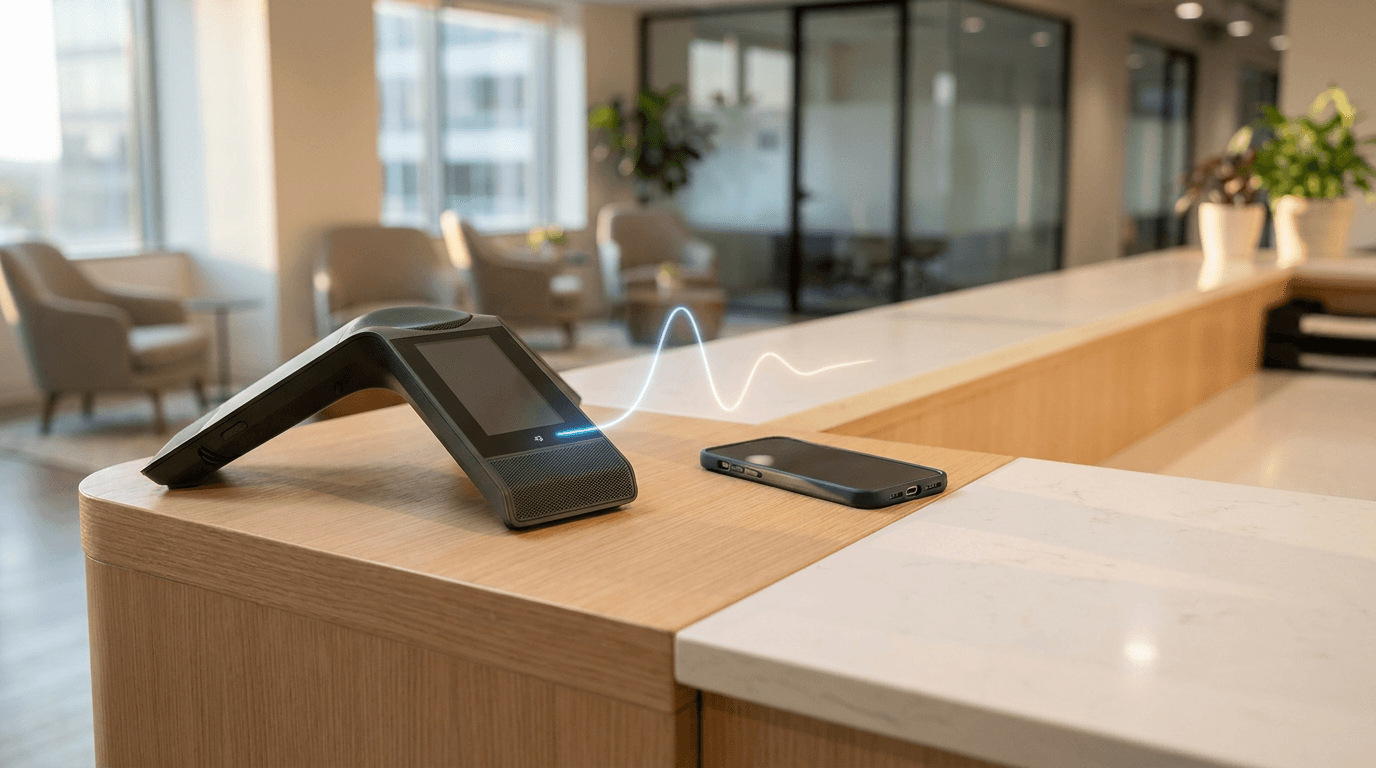
An AI receptionist is software that answers your business phone in a natural voice, handles routine questions, books appointments and hands anything else to a person. It works by turning the caller's speech into text, matching the request to answers and actions you've approved, and replying in a synthetic voice. For a small business that loses calls at lunch, after 5 p.m. or when everyone's already on the line, that's the gap it fills.
It won't replace judgment, and it shouldn't try.
We build these for clients through our AI phone answering service, so this is the version we'd give a friend: what it does, how it works, what it costs, and where it breaks.
What is an AI receptionist?
An AI receptionist is software that picks up your business line and talks to the caller instead of playing a menu or sending them to voicemail. It answers questions about hours, services and pricing from information you approve, books or requests appointments, and texts or emails your team a summary. When a call needs a person, it transfers or takes a detailed message.
You'll also see it sold as an AI answering service, a virtual receptionist or an AI phone agent. Same idea. The differences are in what it connects to and who's accountable when it gets something wrong.
How does an AI receptionist work?
Five pieces do the work on every call. Knowing them helps you question a vendor, because each one can fail on its own.
- Call routing. Your phone system or carrier forwards calls to the assistant: every call, only overflow when lines are busy or unanswered, or only after hours. Callers still dial your usual number.
- Speech recognition. The caller's words are turned into text as they talk, so they say what they need instead of pressing keys.
- A language model with limits. The model works out what the caller wants and drafts a reply, restricted to the information, booking rules and actions you've approved.
- Text-to-speech. The reply is read back in a natural-sounding voice.
- Connections to your systems. Calendar, CRM or practice-software links let it book or log something, and text or email carries the summary to your team.
What happens on a call
- The call reaches the assistant. That can be every call, only overflow when lines are busy, or only after hours. Your phone routing decides.
- It greets the caller and says it's a virtual assistant.
- It figures out what the caller wants from what they say, not from keypad presses.
- It answers from your approved information, or takes an action you've allowed, like booking a slot in a connected calendar.
- If a person is needed, it transfers the call or takes a message, following the fallback you set.
- Your team gets a summary.
An example after-hours call
This example is illustrative, not taken from a client. A caller reaches a small dental practice at 7:40 p.m. The assistant says it's the practice's virtual assistant, hears "I chipped a tooth and it hurts," and follows the rule the dentists set for urgent problems: it takes the caller's name and number, reads the after-hours instructions the practice approved, and texts the on-call dentist a summary. The next caller only wants a cleaning, so the assistant offers open slots from the connected calendar, and the front desk finds the booking and a transcript waiting in the morning.
Is an AI receptionist a good idea for a small business?
Yes, if you're missing calls you'd otherwise win and most of those calls are predictable. After-hours inquiries, overflow at busy times, booking requests and the same five questions every day are where it pays off. If your calls are mostly complex, emotional or high-stakes, it's the wrong tool for the front line.
Check your own phone records first. Pull a month of call logs and split them into answered, voicemail, abandoned and after-hours. Then listen to a sample of the missed ones.
A missed call isn't automatically a lost sale, and you need that baseline before you change anything, or you'll never know whether it worked.
How much does an AI receptionist cost?
Packaged services start cheap and scale with call volume. As of October 2026, Smith.ai's published AI receptionist pricing runs from a free tier of 25 calls a month ($3.00 per call after that) to a $150-a-month Pro plan with 75 calls included, billed month to month. Custom builds cost more up front and usually carry metered AI and phone charges underneath.
Compare that with a person. The Bureau of Labor Statistics puts the median receptionist wage at $18.27 an hour, or $38,010 a year, before benefits. That figure is from May 2025, the latest the bureau had published as of October 2026.
That's not an argument to replace your front desk. It's the number that tells you an AI covering nights and overflow doesn't have to book many jobs to earn its keep.
When you get a quote, make it spell out:
- Setup and the call flows included
- Calendar, CRM or practice-system integrations
- Included minutes or calls, and how overages bill
- Phone carrier charges
- Who monitors usage and who fixes it when it breaks
Then measure outcomes, not calls answered. A message, an appointment request and a confirmed booking are three different results. Our AI receptionist cost breakdown goes deeper on what moves the price.
Which AI receptionist is best for a small business?
The one that handles your call flows on a live test. Make every vendor demo your booking rules, your approved answers, your escalation path and the integrations you actually use. Write down what works today, what needs configuration and what's out of scope.
Packaged tools are faster to start. Custom builds fit odd workflows and stricter security requirements. We compare specific products in our AI receptionist software roundup, and if Smith.ai is on your list, here's how NetSys compares with Smith.ai.
Where does an AI receptionist work, and where doesn't it?
It's strongest at the predictable, high-volume moments: after hours, overflow, appointment booking and repeat questions. It pairs well with AI appointment scheduling when booking is the main job.
It's weak on complicated or emotional conversations, and it should never pretend to be human. The setups we deliver tell callers they're talking to an assistant and hand anything sensitive to a person.
Keep it on inbound calls unless your counsel has approved outbound use. The FCC ruled in February 2024 that AI-generated voices count as "artificial" voices under the Telephone Consumer Protection Act, so the robocall consent rules apply to them, including prior express written consent for telemarketing calls.
Automate the routine, keep people on the judgment calls. That's the same rule behind where AI automation actually pays off.
How do you add one without breaking your phones?
Start with overflow or after-hours only. Many phone systems can route those calls to an assistant while your existing number stays put, but confirm that with your provider before touching the live line.
Run these tests before real callers hit it:
- Routine question: correct answer from your approved info, plus a clear way to reach a person.
- Appointment request: a confirmed calendar entry, or an honest "I've logged your request."
- Out-of-scope question: it says so and the message reaches the right owner.
- Calendar or transfer failure: it doesn't claim success, and someone gets the follow-up.
Use fake caller details for setup. After a short live pilot, review confirmed bookings, failed handoffs and how much staff time went into fixing its mistakes.
If the phone system itself needs work, scope that separately. Our VoIP guide covers it, and if you're on RingCentral, see our comparison with RingCentral AI Receptionist.
Frequently asked questions
Will callers know they're talking to an AI?
They should, and ours say so up front. Most callers don't mind as long as the assistant is quick, gets the answer right and hands them to a person when the question calls for one. Pretending to be human is where trust breaks.
Does an AI receptionist work with my existing phone number?
Usually, yes. Most setups forward calls from the number you already have, either all of them, only when lines are busy or unanswered, or only after hours, so callers dial the same number and you keep your carrier. Ask your phone provider which forwarding options your plan supports, and test them before you change the live line.
Can an AI receptionist book appointments on my calendar?
Yes, when your scheduling platform supports the integration. Test service types, available times, buffers, reschedules and cancellations before launch, because a booking only counts when your calendar confirms it. If the connection fails, the assistant should tell the caller it's logged a request, not claim the slot is theirs.
What's the difference between an AI receptionist and an answering service?
A traditional answering service puts human operators on your calls, usually billed per call or per minute. An AI receptionist handles the conversation itself, around the clock, and can finish tasks like booking instead of just taking a message. Our AI receptionist vs answering service comparison breaks it down.
What happens when the AI can't answer?
It follows the fallback you set: transfer to a person, take a message or schedule a callback. Decide that before launch, then test it with staff unavailable, transfers failing and systems offline. Any vendor who says their assistant never gets stuck hasn't tested it hard enough.
Is AI replacing receptionists?
Not in the small businesses we work with. The common pattern is AI covering nights, weekends and overflow while the front desk handles people in the building and the calls that need judgment. The receptionist stops chasing voicemail and spends the day on work that actually needs a person.
Is an AI receptionist secure enough for client information?
Only if you check. Find out what it collects, where recordings and transcripts live, how long they're kept, who can see them, and get vendor terms in writing before it touches sensitive data. Ours are built by the same engineers who run our cybersecurity work, with least-privilege access to your systems.
By Jamie Baum for The NetSys Group, which has delivered managed IT, cybersecurity and cloud services from Brooklyn since 1998. Our engineers hold degrees in electrical and computer engineering. We work on-site across New York City, Long Island, Westchester, the Hudson Valley, North Jersey and Fairfield County, CT, with remote managed IT nationwide.



Discuss ai phone answering for your business.
Tell us about your current systems, the result you need and your timeline. We will discuss the work, responsibilities and pricing before you decide on an engagement.