
When your only internet line goes down, the whole office stops: no cloud apps, no email, no card processing, no VoIP. Business internet failover fixes that by keeping a second connection ready to take over automatically. Here are the eight questions small business owners ask us most about staying online.
What is business internet failover?
Failover is a setup where a second internet connection takes over the moment your primary line drops. A device at the edge of your network watches the main circuit and, within seconds, reroutes traffic to the backup so staff keep working. Done right, most people never notice the switch happened.
How is that different from just buying two internet plans?
Two plans alone do nothing unless something decides which one to use and switches between them. The failover happens in the router or firewall, not the ISP. Without that hardware and configuration, a second line just sits there while your team scrambles to plug into it manually during an outage.
What does internet downtime actually cost?
More than most owners expect. When the connection is down, sales stall, staff sit idle on the clock, and customers get voicemail. Industry estimates put the price of even a short outage in the thousands for a typical small business, as Business.com documents. A backup line usually costs far less per month than one bad afternoon offline.
Do I need a second wired ISP, or is cellular backup enough?
It depends on how much you rely on the internet. Cellular (4G/5G) backup is affordable and covers a small office that needs to limit the outage to email and card processing. A business running heavy cloud apps or many users is better served by a second wired provider on a different network, so one cut cable does not take out both.
What equipment makes failover automatic?
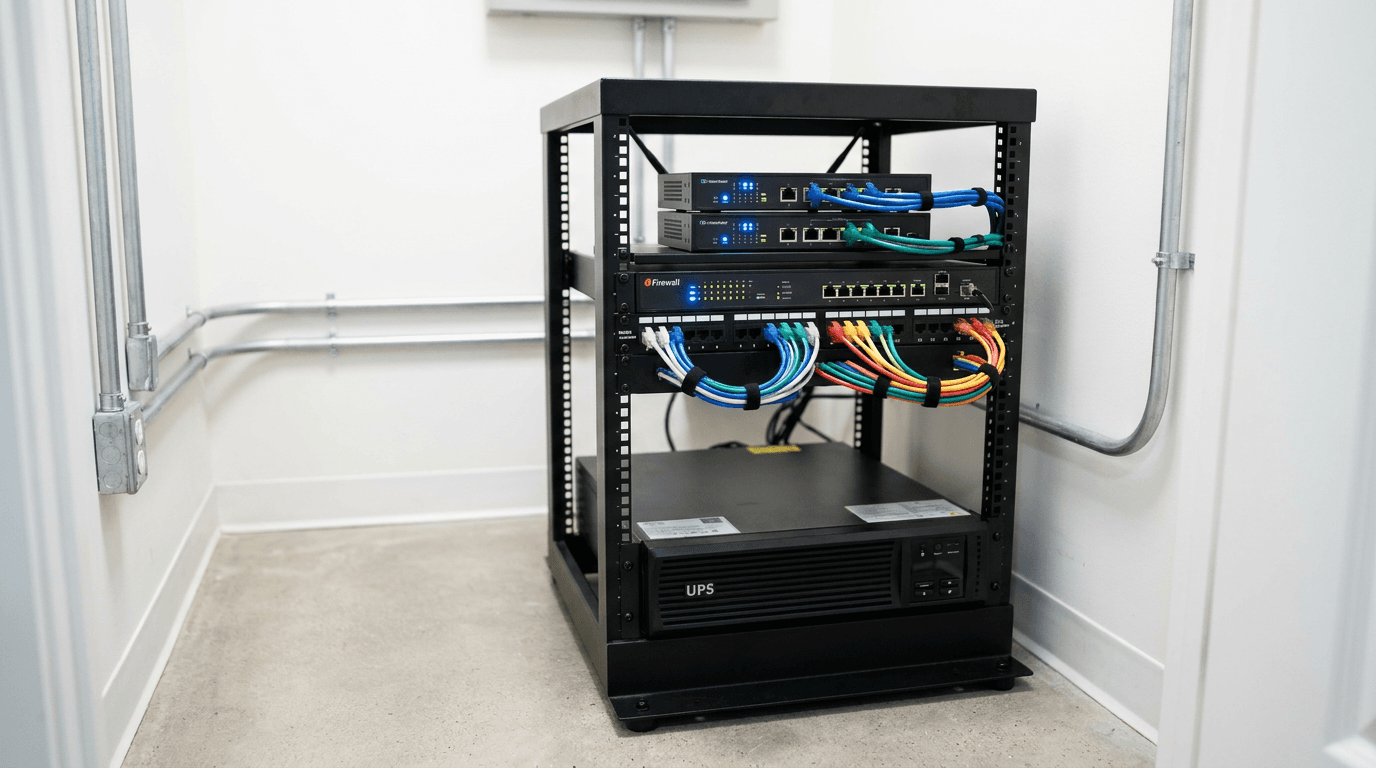
A firewall or router that supports dual WAN (two internet inputs) plus the backup connection itself, often a cellular modem. Pair it with a UPS battery so the gear stays powered through a brief electrical blip. The configuration decides how fast the switch happens and whether it flips back automatically once the main line returns.
Will my phones and card processing keep working?
That is the main reason to have failover. VoIP phones, cloud point-of-sale, and payment terminals all ride on your internet, so when it drops, they drop too. A properly configured failover keeps those services live through an outage, which is often the difference between a quiet inconvenience and a lost day of revenue.
Isn't this the same as SD-WAN?
Related, but not identical. Failover keeps a single site online. SD-WAN is a broader technology that intelligently manages and blends multiple connections, and it shines across several locations. If you run more than one office, read our guide to SD-WAN for multi-location small business. For one location, straightforward dual-WAN failover is usually enough.
How much does failover cost to set up?
Less than most owners assume. You are looking at a dual-WAN firewall, a cellular backup plan billed monthly, and a few hours of configuration. For most small offices the recurring cost is modest, and it pairs naturally with a broader continuity plan. See our backup and disaster recovery FAQ for how the pieces fit together.
By Joe Laboy, The NetSys Group. NetSys has delivered managed IT and networking services since 1998, with engineers certified across Microsoft and Cisco, serving businesses across NY, NJ, CT, PA, and Southwest Florida.
Not sure whether your office would survive an ISP outage? Our managed IT team can review your setup and, if it helps, contact us for a complimentary risk assessment.
Related reading
 FAQ
FAQOffice Move IT Checklist: 8 Questions Small Businesses Ask
Read Article FAQ
FAQBusiness Wi-Fi for Small Business: 8 Questions Owners Ask
Read Article FAQ
FAQMicrosoft Teams Phone for Small Business: 8 Questions
Read ArticleAlso on this topic: Managed IT SLA Response Times: 8 Questions Small Business Owners Ask · SD-WAN for Multi-Location Small Business: 2026 Guide
Discuss business continuity planning for your business.
Tell us about your current systems, the result you need and your timeline. We will discuss the work, responsibilities and pricing before you decide on an engagement.