
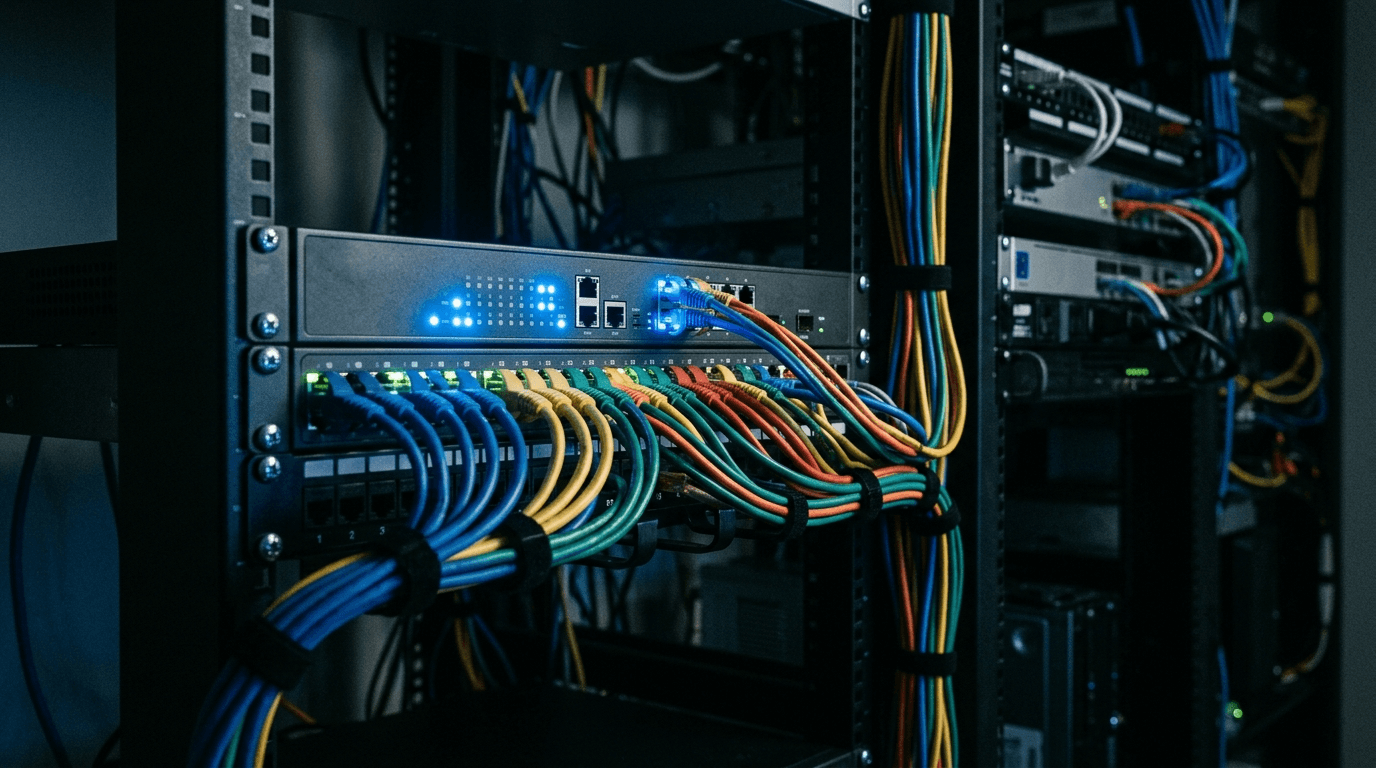
Yes. If your business has employees, email, and any connection to the internet, a business-grade firewall is a baseline security control, not an optional extra. The catch most owners miss is that the firewall built into an ISP-supplied router is not the same thing as a business firewall, and treating the two as equal leaves a real gap. Here is what a firewall actually does, how it differs from your router, and how to decide what your business needs.
Isn't the firewall in my router enough?
For a home, usually. For a business, usually not. A consumer router's firewall mainly hides your internal devices from the open internet and blocks unrequested inbound traffic. That is a floor, not a strategy. A business firewall adds inspection of the traffic that is allowed through, controls over what leaves your network, and visibility into what is happening, which is exactly what a basic router does not provide.
What does a business firewall actually do?
A modern business firewall, often called a next-generation firewall, does far more than block ports. It inspects traffic for known attacks and malware, filters access to malicious or inappropriate websites, and can identify which applications are running on your network rather than just which ports are open. Many include intrusion prevention, encrypted-traffic inspection, and the ability to segment your network so a problem in one area doesn't spread to everything else.
It also gives you a single, enforceable place to apply policy. If you want to block a category of risky sites, require that remote connections come through a secure tunnel, or get alerted when something unusual leaves the network, the firewall is where that lives. Pairing it with endpoint protection like managed detection and response gives you coverage at both the network edge and the individual device.
Router vs. firewall: what is the difference?
A router's job is to move traffic between networks and get your devices online. A firewall's job is to decide what traffic should be allowed and to inspect it. Consumer gear bundles a light firewall into the router, which blurs the line, but the two roles are different. Business-grade equipment separates them properly or combines them in a device built for security first rather than connectivity first. The practical test: can you see and control what is happening on your network, or can you only get online? If it is only the latter, you have a router, not a firewall.
| Consumer router | Business firewall | |
|---|---|---|
| Traffic inspection | Blocks unrequested inbound traffic; does not inspect what it lets through | Inspects allowed traffic for known attacks and malware |
| Outbound control | No control over what leaves your network | Controls what leaves the network and can alert on unusual outbound traffic |
| Visibility & logging | You can get online, but you cannot see what is happening | Visibility into what is happening on your network, with one place to apply policy |
| Security updates | Only protects you if kept current, and the job often has no owner | Firmware updates, rule reviews, and monitoring owned by someone, internal or a provider |
| Support | Supplied by your ISP | Often includes hardware, licensing, and ongoing management in a monthly managed fee |
Do I still need a firewall if everything is in the cloud?
Yes, though the emphasis shifts. Moving email and files to services like Microsoft 365 does not remove the network your people work on every day. You still have devices, printers, point-of-sale systems, and guest Wi-Fi that need protecting, and remote workers still need a secure path in. A firewall enforces that boundary and supports approaches like zero trust, where access is verified rather than assumed. The cloud changes what you protect, not whether you protect it.
The catch: a firewall you don't patch becomes the way in
Buying a firewall is not the finish line. These devices sit at the edge of your network, which makes them a favorite target, and attackers move fast when one has a known flaw. Verizon's 2025 Data Breach Investigations Report found that exploitation of edge devices and VPNs as an initial way into networks jumped from 3% to 22% of vulnerability-based breaches in a single year, nearly an eightfold increase. The same research noted organizations took a median of 209 days to patch these devices, while attackers were exploiting new flaws within about five days.
That gap is the whole point. A firewall only protects you if its software is kept current, and that is where a lot of small businesses fall down, because nobody owns the job. Firmware updates, rule reviews, and monitoring belong to someone, whether that is an internal person or a provider. This is the same discipline behind good patch management everywhere else in your environment. This is the strongest case for a managed firewall: a provider watches the patches, rules, and alerts, so the appliance stays a security control instead of becoming the opening.
By Joel Baum for The NetSys Group, which has delivered managed IT, cybersecurity, and cloud services since 1998. Our engineers hold degrees in electrical and computer engineering and are certified Microsoft and Cisco instructors, serving businesses across NY, NJ, CT, PA, and Southwest Florida.
Frequently asked questions
How much does a firewall cost for a small business?
A business-grade firewall appliance for a small office typically runs from a few hundred to a couple thousand dollars, plus annual security subscriptions for the threat-inspection features. Many providers include the hardware, licensing, and ongoing management in a monthly managed security fee, which spreads the cost and keeps it maintained.
Do I need a firewall if I only have a few employees?
Yes. Attackers scan for exposed networks automatically and do not skip a business for being small. A handful of employees still means devices, email, and internet access that need a controlled edge. The size of the business changes which firewall fits, not whether you need one.
What is a next-generation firewall?
It is a firewall that inspects the content of traffic, not just the ports it uses. On top of basic filtering, it adds intrusion prevention, application awareness, website filtering, and often the ability to inspect encrypted traffic. For most businesses buying today, a next-generation firewall is the standard, not an upgrade.
Does a firewall replace antivirus?
No. A firewall protects the network edge, and antivirus or endpoint detection protects individual devices. They cover different ground, and a laptop taken home or to a coffee shop is outside the office firewall entirely. You want both working together, not one instead of the other.
Not sure whether the box in your closet is a real firewall or just a router? Contact The NetSys Group for a complimentary review of your network security and a straight answer on what your business actually needs.


Discuss network security & firewall management for your business.
Tell us about your current systems, the result you need and your timeline. We will discuss the work, responsibilities and pricing before you decide on an engagement.