
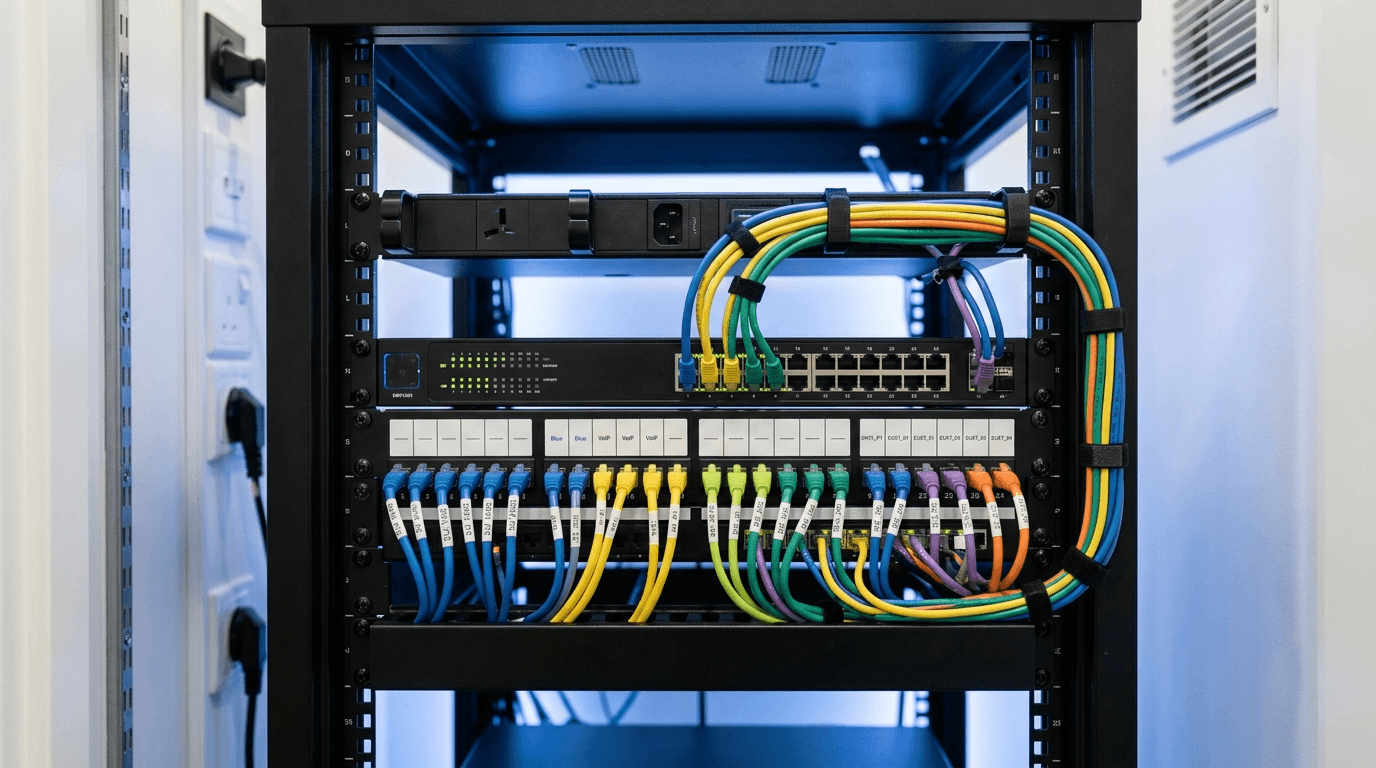
Network segmentation means splitting one flat business network into separate zones so a device in one zone can't freely reach devices in another. It matters because most small-business networks are flat by default: the front-desk PC, the accounting workstation, the guest Wi-Fi, the security cameras, and the server all sit on the same network and can talk to each other without restriction. When an attacker gets a foothold on any one of them, a flat network hands them the rest. Segmentation is the wall that stops a single infected laptop from becoming a company-wide ransomware event.
By Joel Baum. The NetSys Group has delivered managed IT, cybersecurity, and cloud services since 1998. Our engineers hold degrees in electrical and computer engineering and are certified Microsoft and Cisco instructors, serving businesses across NY, NJ, CT, PA, and Southwest Florida.
What does network segmentation actually do?
Segmentation divides your network into smaller sections, usually with VLANs (virtual LANs) and firewall rules, and controls which sections are allowed to talk to each other. Instead of one open space where everything sees everything, you get separate rooms with locked doors between them. A compromised guest device can reach the internet but not your servers, and a hacked camera can't be used to jump into accounting.
The security value comes from limiting lateral movement: the step where an attacker who has broken into one machine spreads sideways to find the data and systems worth encrypting or stealing. Ransomware crews rely on that step. On a flat network it is trivial. On a segmented network, every boundary they hit is another place to be slowed down, detected, and blocked.
Why do small businesses need it now?
Because small businesses are the target, not the exception. The 2026 Verizon Data Breach Investigations Report found ransomware present in 48% of confirmed breaches, up from the prior year, and small and mid-sized organizations made up the large majority of ransomware victims. Attackers automate their way in through phishing, stolen passwords, and unpatched devices, then let the flat network do the spreading for them.
Two changes have made segmentation more urgent for smaller offices specifically. First, the number of connected devices has exploded: cameras, smart TVs, badge readers, thermostats, VoIP phones, and personal phones all live on the network now, and many ship with weak or unchangeable passwords. Second, cyber-insurance underwriters and compliance frameworks increasingly ask whether your network is segmented, and a "no" can raise your premium or sink a claim.
What should a small business separate?
You do not need dozens of zones. A practical starting layout uses four to six segments: a trusted zone for staff computers and servers, a separate zone for guest and customer Wi-Fi, an isolated zone for IoT and cameras, a zone for VoIP phones, and where relevant a locked-down zone for point-of-sale or payment systems. The rule is simple: devices you can't fully control or patch should never share a segment with the data you can't afford to lose.
Guest Wi-Fi is the highest-value, lowest-effort win. If a customer's malware-laden phone connects to the same network as your file server, that is a breach waiting to happen. Putting guests on their own isolated segment takes a competent technician an afternoon. Our business Wi-Fi FAQ covers how guest and staff networks should be kept apart.
How is segmentation different from a firewall?
A firewall guards the boundary between your network and the internet. Segmentation adds boundaries inside your network, so protection doesn't stop at the front door. The two work together: your firewall keeps outsiders out, and segmentation makes sure that when something does get in, it can't roam. If you're still deciding on perimeter protection, start with our guide on whether your small business needs a firewall, then layer segmentation on top.
Where does segmentation fit in a bigger security plan?
Think of it as one of a handful of controls that actually stop attacks rather than just detect them. Segmentation limits how far an intruder can go; endpoint detection and response catches the intrusion on the device; and a zero-trust approach stops trusting devices just because they're "inside" the network. Segmentation is the physical backbone that makes zero trust practical. Our cybersecurity services build these layers together so they reinforce each other instead of leaving gaps.
Done right, segmentation is mostly invisible to your staff. People log in and work as they always have. The difference only shows up on the day something goes wrong, when the damage is contained to one segment instead of the whole company.
Frequently asked questions
Will network segmentation slow down our network?
No. Modern business switches handle VLAN traffic at full speed, and users won't notice a difference in day-to-day work. If anything, separating heavy traffic like security-camera video onto its own segment can improve performance for everyone else by keeping it off the main network.
Do we need to buy new equipment to segment our network?
Often not. Most business-grade managed switches and firewalls already support VLANs and segmentation; the capability is in the gear, it just isn't configured. Consumer-grade equipment usually can't do it well, so the upgrade, if any, is typically the switch or firewall rather than a full replacement.
How long does it take to segment a small office network?
For a typical small office with existing business-grade equipment, a planned segmentation project runs from a day to a few days depending on how many devices and locations are involved. The planning, mapping which device belongs in which zone, usually takes longer than the configuration itself.
Is segmentation the same as zero trust?
They're related but not identical. Segmentation controls which network zones can talk to each other. Zero trust goes further and verifies every user and device on every request, regardless of zone. Segmentation is a foundational building block that makes a zero-trust strategy realistic to implement.
Contain the damage before it starts
A flat network turns a single bad click into a company-wide crisis. Segmentation is one of the most cost-effective ways to make sure it doesn't. If you're not sure how your network is laid out or whether guest and IoT devices are properly isolated, contact The NetSys Group for a complimentary risk assessment and we'll map your current setup and show you where the walls should go.
Related reading
 Cybersecurity
IP Cameras and Door Access: The Network Gap SMBs Miss
Read Article Cybersecurity
Cyber Attack Response Plan for Small Business: 6 Steps
Read Article Cybersecurity
SonicWall VPN Attacks: What SMBs Must Do Now
Read ArticleAlso on this topic: The MOVEit Breach: Supply-Chain Lessons for Every Business
Discuss network & wi-fi management for your business.
Tell us about your current systems, the result you need and your timeline. We will discuss the work, responsibilities and pricing before you decide on an engagement.